
The Boring Middle: A Practical AI Playbook for the Middle Market
Stuck between FOMO and fear of AI? You're not behind — you're being shouted at by people who don't understand your business.
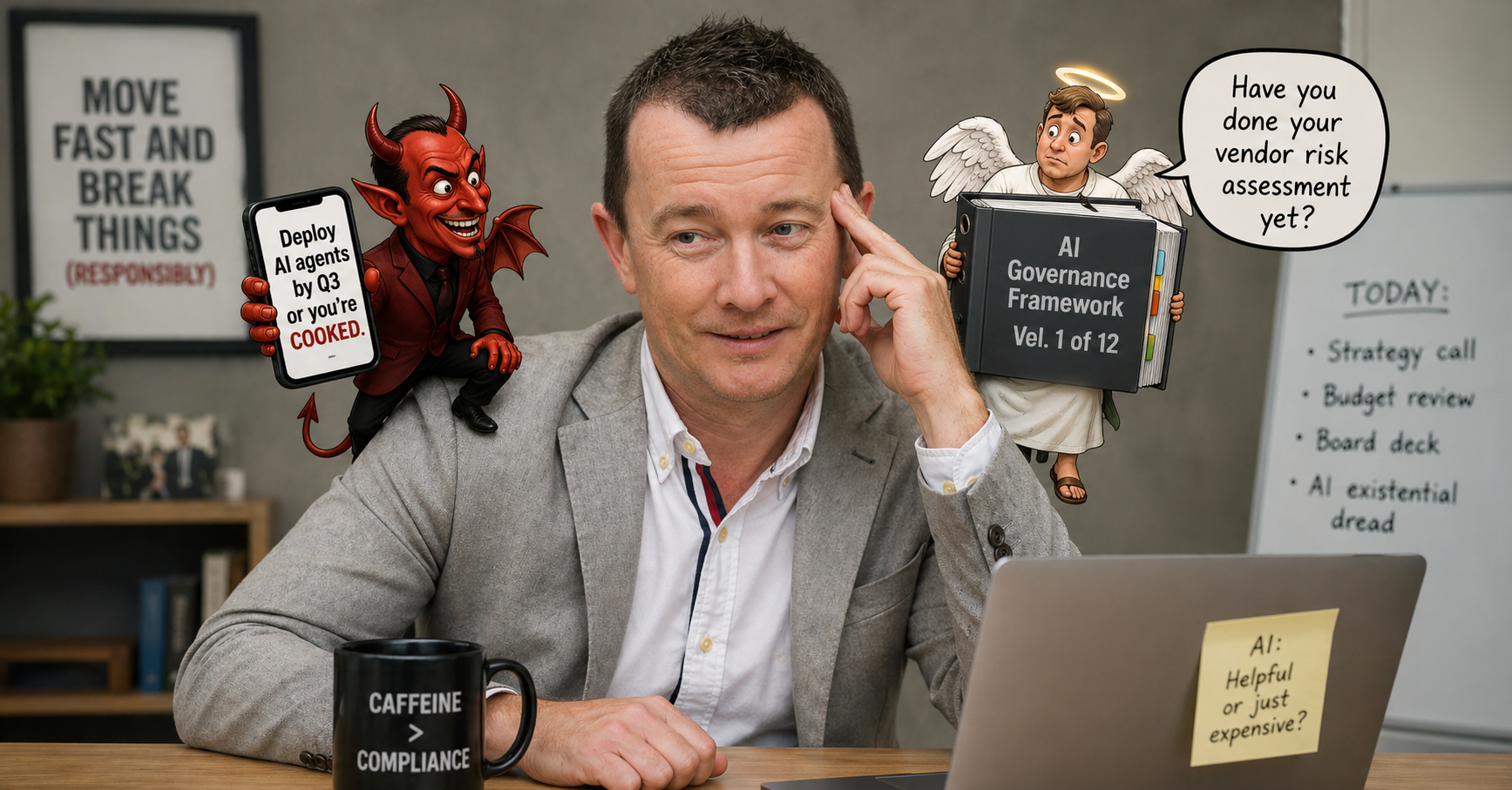
FOMO on one shoulder. Risk paralysis on the other. Sound familiar?
I've spent the past few months on a handful of panels and lunch-and-learns, and I keep noticing the same thing in the room.
It's not the questions people ask out loud. It's the look on their faces when someone else asks the question they've been sitting with.
The look says: "I have no idea what I'm supposed to be doing right now, and everyone around me seems certain."
I'm writing this for that look.
Two voices, one shoulder each
If you run a middle-market business — call it $10M to $250M in revenue — your LinkedIn feed has been screaming at you in stereo for about eighteen months.
One voice tells you that if you're not deploying AI agents by next quarter, your competitors are already eating your lunch and you're cooked. The other tells you not to touch a thing until you've built an AI governance committee, completed a full vendor risk assessment, and hired a Chief Ethics Officer.
And somewhere in the middle, you're trying to figure out whether the new tools can help your team stop copy-pasting between three systems.
Enterprise can afford the committee. You can't.
Here's the honest cut: the AI conversation has been dominated by enterprise voices, because enterprise pays for the conferences, sponsors the panels, and writes the LinkedIn thinkfluencer takes.
Enterprise has the muscle to do this slowly. Dedicated AI budget, a Chief AI Officer, a cross-functional committee, a legal team that can spend six months on a vendor review. If they move at the speed of a glacier, that's fine — they can absorb the cost of being slow.
You can't move that slowly. But here's the part the FOMO crowd misses: you also can't afford to end up on the front page of the Wall Street Journal because someone in finance pasted your customer list into a free AI tool. (For a real-world warning shot, see our breakdown of the Heppner ruling and AI data exposure.) A middle-market business doesn't have the brand armor or the legal war chest to survive that kind of headline. One bad incident isn't a bad quarter. It's an existential event.
You're stuck between FOMO and risk paralysis at the same time. That's not a strategy problem. That's a positioning problem. The way out isn't to pick a side — it's to refuse the false choice.
The boring middle
You don't need an AI committee. You need four things, and you can have them inside of 30 days.
1. Clean enough data that the tools actually work
This is the unglamorous truth nobody on the panels wants to talk about. The AI tools you're being sold are only as smart as the data you feed them. Garbage data in, confident-sounding garbage out. If your CRM has 40% of contacts missing email addresses, your customer list lives in three different spreadsheets, and your sales team spells the same account name four different ways — no AI tool is going to fix that. It's going to amplify it. Data quality and data cleanup are the prerequisites, not the afterthoughts.
2. A short list of what NOT to put into a chat window
Not a 47-page policy. A one-page document that says, in plain English: customer PII stays out of consumer AI tools, financials stay out of consumer AI tools, anything covered by an NDA stays out of consumer AI tools, and here's the approved tool we use for sensitive work. Print it. Hand it out. Done.
Download the one-page checklist (PDF)3. One person who owns it. Not a committee.
Committees are how middle-market companies LARP as enterprise. They produce meeting notes, not progress. Pick one person — ideally someone close to operations, not legal — and give them the authority to make calls. That person becomes your internal switchboard for "can I use this tool for this thing?" Most of your AI questions are operational, not philosophical. Treat them that way.
4. Permission to start small
Pick one workflow. The one that's been a pain in your team's neck for six months. Apply AI to that workflow. Measure whether it actually saved anyone time or money. Repeat. This is how returns compound. Big-bang AI strategies fail. Boring small wins stack. Our Discovery engagement is built around exactly this kind of small-but-real first step.
Why this works
The companies winning with AI right now aren't the first movers and they aren't the most cautious. They're the ones who quietly got their data house in order so that when they adopted a tool, it had something useful to work with.
Clean data doesn't make a great LinkedIn post. AI committees don't either, honestly. But the middle-market companies that focus on those two things in 2026 are going to look like geniuses in 2027, while their louder competitors are still trying to figure out why their AI pilot didn't go anywhere.
If your team is stuck right now between FOMO and fear, you're not behind. You're just being shouted at by people who don't understand your business.
Pick the boring middle. It's where the real returns live.
Ready to skip the AI theater and do the real work?
USC Data helps middle-market companies get their data foundation right so they can move on AI — and everything else — with confidence. If your data is the thing in the way, let's talk.